
When a Child's "Wrong" Word Reveals the Deepest Truth About Learning
There's a story that perfectly captures what we've been losing in modern education. A young girl, riding in the car with her parent, asks to take "the low way" instead of the highway. She hadn't learned the correct terminology, but she had done something far more impressive: she identified a problem — being stuck in slow traffic — and invented her own logical solution using the tools available to her. She reasoned, she created, she communicated. That's not a language error. That's creativity at its most pure.
This small, charming moment raises a large and urgent question: If children arrive in the world wired for creative problem-solving, why do so many of them lose that instinct by the time they reach middle school? And more importantly, what can educators do to stop — and reverse — that loss?
The Creativity Crisis in K-12 Education
Creativity isn't just a nice-to-have skill for artists and musicians. It is a foundational cognitive capacity that underpins innovation, resilience, critical thinking, and adaptability — exactly the skills that today's workforce and society urgently need. Yet research consistently shows that creative thinking among students declines as they progress through formal schooling.
A 2024 report examining creativity in educational settings found that standardized assessment systems, rigid curricula, and pressure for measurable outcomes have gradually squeezed the space that students once had to explore, experiment, and fail productively. When every lesson has a predetermined correct answer and every assessment is designed for efficiency and scalability, there is simply no room for the kind of open-ended thinking that fuels genuine creativity.
This isn't a criticism of teachers. Educators are operating within systems that reward compliance over curiosity, performance over process. The problem is structural — and solving it requires a structural response.
What Creativity Actually Looks Like in the Classroom
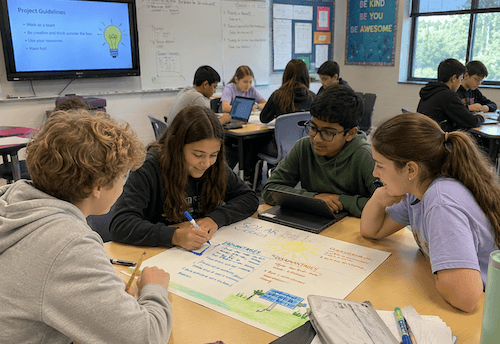
One of the biggest misconceptions about creativity in education is that it belongs only in art class, music, or elective courses. In reality, creative thinking is a process that can and should be embedded across every subject area. It's the decisions students make when the path isn't clearly laid out for them — when they have to navigate from Point A to Point B without a map.
Authentic creativity in the classroom looks like:
- Students designing their own experiments to test a scientific question rather than following a scripted lab procedure
- Writers revising their work based on genuine feedback rather than correcting errors on a worksheet
- Math students exploring multiple solution paths and comparing strategies rather than practicing a single algorithm
- History students crafting arguments supported by primary sources rather than reproducing information from a textbook
In each of these cases, the student is doing the intellectual heavy lifting. They are making decisions, taking risks, and discovering something — about the subject, and about themselves as thinkers.
The Four Keys to Creating Space for Creativity
Reclaiming creativity doesn't mean abandoning rigor or structure. It means redesigning the conditions under which learning happens so that students have agency, purpose, and room to grow. Research on student-led inquiry and innovative teaching points to several key principles that educators can apply immediately.
1. Start With Genuine Questions
Creativity thrives when students are working on problems that don't have obvious answers. Rather than launching a unit with a lesson, try launching it with a question — one that even you, as the teacher, don't fully know how to answer. This signals to students that thinking, not recall, is the point.
2. Build in Time for Revision
One of the most creativity-killing habits in schools is the single-draft culture. When students turn in work once and receive a grade, they learn that completion is the goal. When they revise, share, rethink, and improve, they learn that quality thinking is iterative — exactly how creativity works in the real world.
3. Celebrate Process, Not Just Product
If the only feedback students receive is on their final output, they'll optimize for the output. Start documenting and discussing the process: the dead ends, the surprising discoveries, the moments where a "wrong" idea led somewhere interesting. This is where creative development actually happens.
4. Give Students Meaningful Choice
Agency is the engine of creativity. When students have some control over how they demonstrate understanding — through writing, video, presentation, model-building, or debate — they are far more likely to invest creatively in the task. Choice doesn't mean chaos; it means purpose-driven flexibility within a clear framework.
Why This Matters More Than Ever
We are preparing students for a world that doesn't yet fully exist. The jobs many of today's kindergartners will hold haven't been invented. The problems they'll need to solve don't have textbook solutions. In that context, the ability to think creatively — to find "the low way" when the highway is gridlocked — isn't supplemental. It's essential.
Assessment and accountability absolutely matter. Schools need to measure learning and ensure equity. But measurement systems were never meant to become the ceiling of what's possible in a classroom. They were meant to be the floor.
A Call to Educators: Reclaim the Space
Teachers don't need permission to be creative in how they teach — and students don't need permission to be creative in how they learn. What both groups need is a school culture that recognizes creativity as a discipline, not a decoration. One that values the messy middle of learning, not just the polished final product.
The next time a student gives you an answer that's technically "wrong" but reveals genuine original thinking, pause before correcting. Ask them to explain their reasoning. Follow their logic. You might find yourself on the low way — and it might just be the fastest route to somewhere meaningful.
Reclaiming creativity in schools isn't about adding one more program or initiative. It's about shifting what we celebrate, what we make time for, and what we signal matters. Children come to us as natural innovators. Our job is to make sure school doesn't teach them out of it.