
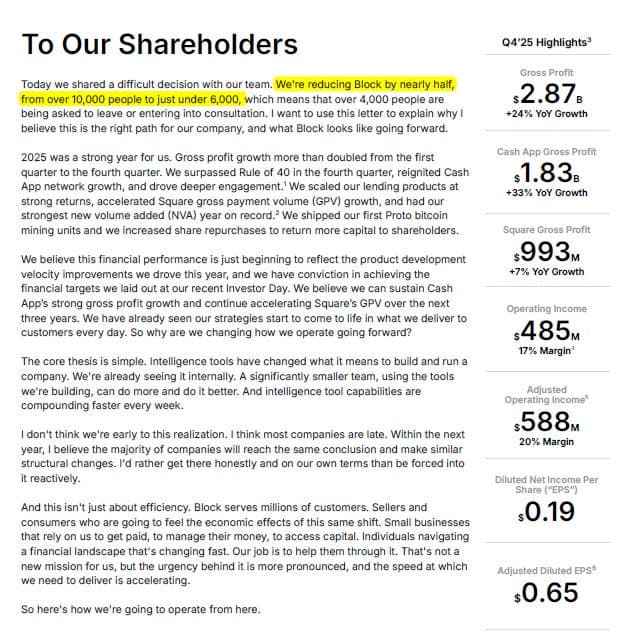
Jack Dorsey Drops a Bombshell: 4,000 Jobs Gone, AI Takes Over
In one of the most striking corporate announcements of 2025, Jack Dorsey, CEO of Block Inc. — the fintech company behind Square and CashApp — revealed plans to lay off approximately 40% of its workforce. With over 10,000 employees on payroll, that figure translates to roughly 4,000 people losing their jobs. The reason cited was straightforward and unapologetic: artificial intelligence will fill the gap. The announcement was brief, light on specifics, and heavy on implications — not just for Block's employees, but potentially for the entire tech industry and beyond.
For workers, investors, and policy analysts alike, the question immediately became: is this an isolated business decision, or is Block's move the opening act of a much larger transformation sweeping through corporate America and the global economy?
What We Know About Block's AI Replacement Plan
Dorsey's announcement offered few operational details about how exactly AI would absorb the roles previously held by thousands of human employees. What was made clear, however, is that the decision was deliberate and strategic, not a cost-cutting reaction to a bad quarter. Block has been investing heavily in AI integration across its product suite, and leadership appears convinced that the technology has matured to a point where it can perform functions — customer support, data analysis, compliance monitoring, and possibly software development — at a scale and efficiency that human teams cannot match at comparable cost.
Block is not a struggling startup scrambling to survive. Square and CashApp together process billions of dollars in transactions and serve millions of merchants and consumers. This is a profitable, established fintech giant making a proactive bet on an AI-first operational model. That context matters enormously when evaluating whether this represents a one-off bold move or a preview of what other companies will do in the months and years ahead.
Is This a Bellwether? Reading the Broader Signals
A bellwether, in financial and economic terms, is an indicator that signals broader trends before they become widely apparent. The question of whether Block's layoff announcement qualifies as one depends on how representative the company's situation is relative to the rest of the market.
Several factors suggest it very well could be:
- AI capability has crossed a threshold. Large language models, agentic AI systems, and automation tools have advanced rapidly enough that tasks previously requiring human judgment — writing, coding, analysis, customer interaction — are now automatable at scale. Block is one of the first major companies to act on this publicly, but it is unlikely to be the last.
- Corporate incentives are aligned with AI adoption. Labor is one of the largest cost centers for most technology and financial services companies. When a CEO can credibly tell shareholders that AI can perform the same work at a fraction of the cost with greater consistency, the pressure to act is enormous. Boards and investors are watching Block closely.
- The tech sector has already been shedding jobs. Tens of thousands of technology workers have been laid off across the industry since 2022. While many of those reductions were framed around overhiring during the pandemic boom, the pattern has continued well past any correction-phase explanation. AI is increasingly cited as the underlying structural driver.
- Other high-profile executives have made similar signals. Leaders across sectors, from financial services to media to logistics, have publicly discussed reducing headcount in favor of AI tooling. Dorsey's announcement was louder and more specific than most, but the sentiment is widespread.
The Case Against Treating This as a Universal Warning
Not everyone agrees that Block's decision represents a template others will follow. Skeptics make several reasonable points worth considering.
First, Block operates in a domain — fintech and digital payments — that is particularly well-suited to AI automation. The nature of its work involves high volumes of structured, repeatable tasks that AI handles well. Industries that rely on physical labor, complex human relationships, creative problem-solving in ambiguous environments, or highly regulated interpersonal judgment may not face the same displacement pressure at the same speed.
Second, history shows that technological transitions tend to eliminate certain job categories while creating new ones. The introduction of the internet, cloud computing, and mobile platforms all disrupted labor markets and generated widespread concern about job losses — but overall employment in the tech sector grew substantially through each of those transitions. AI may follow a similar pattern, augmenting human productivity and generating entirely new categories of work that we cannot yet fully envision.
Third, the specifics of Dorsey's announcement remain vague enough that the actual implementation could look very different from the headline. "Replacing workers with AI" is a narrative that resonates publicly, but the operational reality of how AI handles nuanced customer complaints, regulatory edge cases, or product strategy decisions may force a more moderate outcome than the announcement implies.
What Workers and Job Seekers Should Take Away
Regardless of whether Block's move turns out to be a true bellwether, the announcement sends a clear signal that workers at every level should heed. AI literacy is no longer optional. The professionals who will remain valuable in an AI-saturated job market are those who understand how to work alongside AI tools, direct them effectively, evaluate their outputs critically, and apply uniquely human capabilities — empathy, ethical reasoning, creative strategy — in ways that machines cannot replicate.
Job seekers entering competitive fields should be actively building skills in AI tool usage, data interpretation, and prompt engineering. Those already employed should advocate for AI training programs within their organizations rather than waiting to be displaced before adapting.
What Policymakers and Regulators Need to Consider
Block's announcement also puts pressure on governments and regulatory bodies that have been slow to develop frameworks for AI-driven workforce displacement. Questions around severance obligations, retraining funding, unemployment safety nets, and corporate accountability for AI-related layoffs are becoming urgent rather than theoretical.
Several countries in Europe have already begun exploring AI impact assessments as a precondition for large-scale workforce automation. In the United States, the policy conversation is still in early stages. If Block's 40% reduction proves to be the first of many similar announcements, the timeline for meaningful legislative response will need to compress significantly.
The Bottom Line: Prepare, Don't Panic
Block Inc.'s decision to cut 40% of its workforce and hand those responsibilities to AI is significant, attention-worthy, and potentially indicative of a broader trend. Whether it qualifies as a true bellwether for the broader economy remains to be seen — but the prudent assumption is that it represents the leading edge of something real and accelerating. For workers, companies, and governments alike, the appropriate response is not alarm but urgent, practical preparation. The AI transition is not coming. For thousands of Block employees, it has already arrived.