
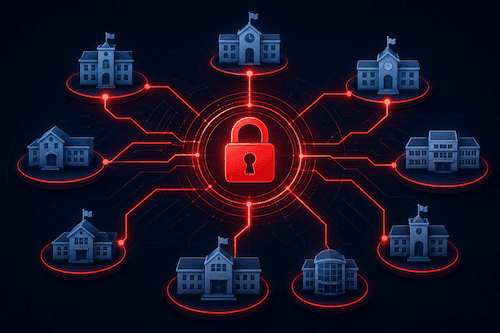
The Canvas Breach: A Defining Moment for Education Cybersecurity
The recent Instructure/Canvas data breach has sent a shockwave through the education technology community. For school districts and universities that rely on Canvas as a central platform for teaching and learning, the incident is more than a headline—it is a stark reminder that the digital infrastructure underpinning modern education is deeply vulnerable. The question is no longer whether schools will face a cyberattack, but whether they are prepared to respond when one occurs.
Education's attack surface has expanded dramatically over the past decade. It is no longer confined to district-owned servers, on-premises firewalls, or school-issued laptops. Today, it stretches across cloud-hosted learning management systems, identity platforms, student information systems, third-party applications, and remote access tools. When any one of those interconnected layers is compromised, the ripple effects can be far-reaching and long-lasting.
What the Instructure/Canvas Breach Revealed
The Instructure/Canvas breach exposed a fundamental gap in how many educational institutions think about security. Too often, schools and universities assume that because a vendor is large, reputable, and widely used, their data is inherently safe. The Canvas incident proves otherwise. Even well-resourced, enterprise-scale platforms are not immune to sophisticated threat actors who are increasingly targeting the education sector.
What makes this breach particularly significant is not just the scope of the data exposed, but the systemic vulnerability it illuminates. Millions of students, educators, and administrators interact with platforms like Canvas every single day. That volume of sensitive data—including names, email addresses, institutional credentials, and in some cases academic records—represents an extraordinarily attractive target for hackers. When attackers gain access to a central learning platform, they may also gain a foothold into connected systems that schools never anticipated being at risk.
Why Traditional Security Models Are No Longer Sufficient
For years, many school IT departments operated under a perimeter-based security model: build a strong enough wall around the network, and threats will stay outside. That model is now dangerously outdated. The widespread adoption of cloud-based tools, remote and hybrid learning, and personal devices has dissolved the traditional network perimeter entirely.
Modern education environments demand a fundamentally different approach. Protecting student and staff data requires visibility across every system, every user account, and every third-party integration. It requires knowing not just what is on the network, but who is accessing what, from where, and under what circumstances. A breach originating in a third-party vendor—as the Canvas incident demonstrates—can be just as damaging as one that originates inside the district's own systems.
The Case for Zero Trust Architecture in Education
Zero Trust security has moved from a buzzword to a genuine operational necessity for education institutions. The core principle is simple but powerful: never automatically trust any user, device, or system, regardless of whether they are inside or outside the network. Every access request must be verified continuously, every permission must be explicitly granted, and every anomaly must be flagged and investigated.
For K-12 schools and higher education institutions, implementing Zero Trust means rethinking identity management, enforcing multi-factor authentication across all platforms, segmenting network access so that a breach in one area cannot cascade into others, and continuously monitoring for unusual behavior. It also means applying rigorous scrutiny to every third-party vendor and platform before granting them access to institutional data.
Districts cannot prevent every breach—no organization can. But they can absolutely control how much damage a breach causes when it occurs. A well-implemented Zero Trust framework limits lateral movement within a network, minimizes the blast radius of any single compromise, and dramatically shortens the time it takes to detect and contain a threat.
Third-Party Vendor Risk Management Must Be a Priority
One of the most urgent lessons from the Canvas breach is that vendor risk management can no longer be treated as a box-checking compliance exercise. Schools need to conduct thorough security assessments of every platform they use, from learning management systems and assessment tools to communication apps and parent portals.
This means asking hard questions before signing a contract: How does the vendor encrypt data at rest and in transit? What is their incident response plan? How quickly do they notify customers of a breach? Do they conduct regular third-party security audits? What happens to institutional data if the relationship ends?
It also means establishing contractual obligations around breach notification timelines, data minimization, and the right to audit. Schools have a legal and ethical responsibility to protect the students and staff whose data they steward. That responsibility does not disappear simply because the data lives on someone else's servers.
Building a Culture of Digital Resilience
Technology solutions alone are not enough. Sustainable cybersecurity in education requires building a culture of digital resilience across the entire institution—from the superintendent's office to the classroom. Teachers, administrators, students, and parents all play a role in maintaining security hygiene.
- Regular cybersecurity training for all staff, not just IT personnel, should be treated as a core professional development requirement rather than an optional add-on.
- Students should receive age-appropriate digital literacy education that includes understanding phishing, password security, and privacy awareness.
- Incident response plans should be tested regularly through tabletop exercises so that when a real breach occurs, staff know exactly what to do and who to call.
- Leadership must champion cybersecurity as a strategic priority, not an IT afterthought—because resource allocation follows organizational values.
The Moment to Act Is Now
The Canvas breach is a wake-up call that the education sector cannot afford to ignore. Every day that schools delay meaningful investment in modern cybersecurity practices is another day that student data, staff records, and institutional systems remain unnecessarily exposed. The threat landscape is only growing more sophisticated, and threat actors have made clear that education is a high-value target.
Districts and universities that take action now—by adopting Zero Trust principles, strengthening vendor oversight, investing in staff training, and building robust incident response capabilities—will be far better positioned to protect their communities when the next breach attempt arrives. And make no mistake: it will arrive. The only question is whether schools will be ready.
The lesson from Instructure and Canvas is clear: modern education security requires far more than firewalls and endpoint protection. It requires a comprehensive, layered strategy that treats cybersecurity not as a cost center, but as a fundamental pillar of educational continuity and student safety.